
Beyond Albuquerque and Santa Fe, New Mexico: Acoma Pueblo and Ghost Ranch


New Mexico is a place I’ve returned to again and again. I have family here, and over the years. While I love Albuquerque and Santa Fe, this beautiful, culturally rich state has so much more to offer. Two places in particular are worth building into a New Mexico itinerary: Acoma Pueblo and Ghost Ranch. They are very different places, separated by geography, history, and culture, but both reveal something essential about New Mexico. Here, the landscape isn’t simply scenery. It is part of the story.
Acoma Pueblo: 900 Years Above the Desert

About an hour west of Albuquerque, Acoma Pueblo rises dramatically from the desert atop a sandstone mesa. Known as Sky City, Acoma has been home to its people for more than 900 years and remains a living community today. That distinction is important. This isn’t an archaeological site or an abandoned settlement preserved for visitors, but a place where generations of Acoma people have lived, worshipped, and maintained their traditions for centuries.
Visiting is therefore different from stopping at another historic attraction along a road trip. Access to the Pueblo is through a guided tour, and visitors are guests of the community. The experience begins below the mesa at the Sky City Cultural Center, then continues to the village above. Once you’re at the top of the mesa, the scale of the landscape is extraordinary: adobe buildings rise from the earth while the desert stretches outward beneath an enormous New Mexico sky.
One of the most memorable parts of the experience comes at the end. Rather than return from the mesa by vehicle, visitors comfortable with the descent can walk down from Sky City, following the designated path and negotiating the steep rock steps toward the desert floor. Acoma’s visitor guidelines specifically ask those making the descent to remain on the path. It’s a physical experience of the mesa that a photograph can’t quite convey; you stop simply looking at the height and begin to feel the history beneath your feet.
Ansel Adams photographed the Pueblo during his 1941–42 work for the U.S. Department of the Interior. His photographs capture the remarkable relationship between adobe, earth, water, and sky. But the images are moments within a much longer history. The community Adams photographed had already existed for centuries before his arrival and continues today.
A Few Things to Know Before You Go
This is one place where travelers should do a little preparation before arriving. Dress respectfully. Acoma specifically asks visitors not to wear revealing clothing on the reservation and mesa top. Photography is carefully regulated. Visitors should review the current rules before arriving and obtain any required photography permit. There are places and occasions where photography isn’t permitted at all, and tribal members and their artwork shouldn’t be photographed without permission.
It is also important to check Acoma’s calendar before planning your visit. The Pueblo closes to visitors on certain dates, while the calendar also includes feast days, traditional dances, and other special events. Plans and access can change, so check shortly before your trip rather than assuming a date that works on your itinerary will be a normal visitor day.
Ghost Ranch: Inside an O’Keeffe Painting

North of Santa Fe, the road toward Abiquiú leads into a very different New Mexico. The landscape grows increasingly dramatic as bands of red, ochre, and cream emerge from the desert and cliffs rise against an almost impossibly blue sky. It’s beautiful even if you know nothing about Georgia O’Keeffe. If you do know her work, however, there is a strange sensation of recognition. You have seen these shapes before.
O’Keeffe first came to New Mexico in 1929 and returned repeatedly before eventually making northern New Mexico her permanent home. The hills, mesas, and immense spaces she encountered here became part of her visual language. Ghost Ranch in particular appears again and again in her work, not as a literal record of the landscape but as something distilled: color intensified, forms simplified, geology transformed into sweeping bands and curves.
One of the works I included in my Reel on Instagram is her 1934 painting Purple Hills Ghost Ranch – 2. When you see the painting beside the landscape that inspired it, O’Keeffe’s choices become easier to understand. Those purples and pinks don’t seem quite so fanciful anymore. The folds of the hills really do seem to move across the horizon in great waves of color. At Ghost Ranch, you can stand in a living painting.
That is why I wouldn’t experience this part of New Mexico solely through the window of a car. Give yourself time to walk. The pleasure isn’t simply finding a particular O’Keeffe view and photographing it, but slowing down enough to notice what she noticed: the layers of color, the strange folds of the geology, and how the entire landscape changes as the desert light moves across it.
And you don’t necessarily have to leave at the end of the day. You can stay at Ghost Ranch, in simple accommodations that put you right in the middle of the landscape. The ranch also offers workshops and retreats, so you can spend several days here rather than treating Ghost Ranch as another stop on a New Mexico road trip.
For the right traveler, I love that idea. There is something very different about visiting a landscape for an afternoon and actually inhabiting it for a while: waking up surrounded by those cliffs, walking through them in the morning light, and spending a few days making, writing, learning, or simply paying closer attention. In a place so closely associated with an artist who spent decades looking at the same hills, slowing down feels particularly appropriate.
Our Own Connection to New Mexico
This particular intersection of art and landscape also resonates with us for personal reasons. I have family in New Mexico, so I’ve been coming here for years, long before I began Skylark Journeys. Jake also has a connection to O’Keeffe: he produced the 2009 film Georgia O’Keeffe, starring Joan Allen as O’Keeffe and Jeremy Irons as Alfred Stieglitz. The production brought him to New Mexico and included filming at O’Keeffe’s home, giving him the unusual experience of working within the landscape—and the spaces—that shaped so much of her later life and art.
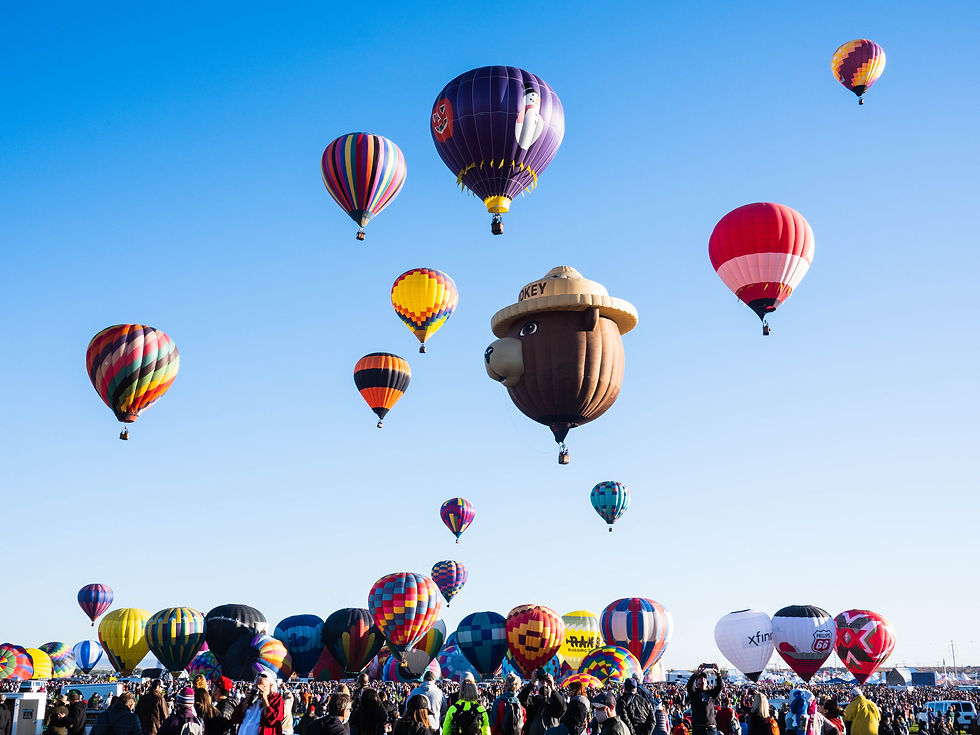
Perhaps that’s part of why we experience New Mexico somewhat differently. I don’t think of it simply as Santa Fe galleries, adobe hotels, green chile, and the Balloon Fiesta, wonderful as all of those things are. What keeps drawing me back is the connection between the land and the people who have lived in it, interpreted it, and made art from it across generations.
If you come to New Mexico for the Balloon Fiesta, stay longer. Go west from Albuquerque to Acoma and make the descent from Sky City on foot. Then head north, beyond Santa Fe, toward Abiquiú and Ghost Ranch, and walk through the hills O’Keeffe painted almost a century ago. These aren’t simply side trips from the better-known attractions of New Mexico. For me, they’re part of what makes the state worth returning to in the first place.
Planning a trip to New Mexico? I can help you turn Albuquerque, Acoma Pueblo, Santa Fe, Abiquiú and Ghost Ranch into a journey rather than a checklist—from where to stay to the experiences worth building the trip around.
Comments